ENGINEERING / 008
How to Build a Professional
Contractor Estimate
A practical guide to labor, materials, direct costs, markup, margin, job profit and customer-ready estimates — and why M&N Soft built Qalcu as a free estimating toolkit for contractors and small businesses.
01 / THE ESTIMATING PROBLEM
A contractor can do excellent work and still lose money because of a bad estimate.
For many small contractors, estimating starts with experience: look at the job, think about how long it should take, estimate the materials and give the customer a number. That can work — until one forgotten cost, an incorrect markup or a few extra hours erase the expected profit.
The problem is not that contractors do not understand their work. The problem is that estimating combines several different financial questions into one number: labor, materials, subcontractors, direct expenses, overhead, markup, margin and profit.
LABOR
   +
MATERIALS
   +
SUBCONTRACTORS
   +
DIRECT JOB COSTS
   ↓
TOTAL COST
   +
MARKUP
   ↓
SELLING PRICE
   ↓
EXPECTED PROFIT
02 / WHY ESTIMATING GETS COMPLICATED
The customer sees one price. The contractor has to understand everything behind it.
A quote may look simple from the outside, but the number can represent dozens of assumptions. How many workers are needed? How many hours? What materials are required? How much waste should be expected? Is equipment rental needed? Is part of the job subcontracted?
Small errors compound. Underestimating labor by several hours and forgetting a delivery charge may not look serious individually, but together they can consume a significant part of the expected profit.
03 / LABOR
Labor is more than the hourly wage.
A useful estimate starts with the expected amount of work. Contractors should think in terms of people, hours and the actual cost associated with delivering those hours.
WORKERS × HOURS × LABOR COST
              ↓
        DIRECT LABOR COST
Travel, setup, cleanup, loading, preparation and other job-related time can also matter. If those hours are necessary to complete the project, ignoring them does not make them free.
04 / MATERIALS
Material cost should reflect what the job actually consumes.
Estimating materials means more than copying the price of the main product from a store. Fasteners, adhesives, trim, consumables, delivery and other supporting materials can change the real cost.
Waste also matters. Cuts, breakage, damaged pieces and minimum package sizes can mean the amount purchased is greater than the theoretical amount installed.
REQUIRED QUANTITY
      +
EXPECTED WASTE
      ↓
PURCHASE QUANTITY
      ×
UNIT COST
      ↓
MATERIAL COST
05 / DIRECT JOB COSTS
Some costs belong to the project even though they are neither labor nor material.
Equipment rental, disposal, permits, delivery charges, specialized services and subcontractors may all affect the cost of a particular job. A useful estimating process gives those costs a place instead of hoping the markup will accidentally cover them.
06 / MARKUP
Markup converts cost into a selling price.
Once direct costs are understood, a contractor can apply markup. Markup is calculated from cost. A 20% markup on $10,000 of cost adds $2,000 and produces a $12,000 selling price.
COST:             $10,000
MARKUP:                20%
                     ───────
MARKUP AMOUNT:      $2,000
SELLING PRICE:     $12,000
Qalcu provides a free Contractor Markup Calculator for this calculation.
07 / MARKUP IS NOT MARGIN
Confusing markup and margin can quietly change the economics of a job.
Markup is measured against cost. Profit margin is measured against the selling price. Because the denominators are different, the same percentage does not represent the same thing.
COST                  $10,000
SELLING PRICE          $12,000
PROFIT                  $2,000

MARKUP
$2,000 ÷ $10,000 = 20%

MARGIN
$2,000 ÷ $12,000 = 16.67%
This distinction becomes increasingly important when a business uses target margins to plan pricing and profitability.
08 / JOB PROFIT
A busy schedule does not automatically mean a profitable business.
Revenue tells you how much the customer pays. It does not tell you how much the company keeps after the job costs are paid.
Contractors should be able to look at a proposed selling price and understand the expected dollar profit and profit margin before the estimate goes to the customer.
The free Qalcu Job Profit & Margin Calculator is designed for exactly that check.
09 / A SIMPLE ESTIMATE EXAMPLE
Build the price from the job upward instead of guessing the final number.
LABOR                 $3,200
MATERIALS              $4,100
SUBCONTRACTOR            $900
OTHER DIRECT COSTS        $300
                     ─────────
TOTAL DIRECT COST       $8,500

25% MARKUP              $2,125
                     ─────────
ESTIMATED PRICE        $10,625
This is intentionally simplified. Real businesses may also need to account for taxes, overhead allocation, discounts, contingency and other factors appropriate to their work.
The important idea is that the selling price can be explained. It comes from a cost structure and a pricing decision rather than intuition alone.
10 / THE CUSTOMER ESTIMATE
A correct calculation still needs to become a professional document.
Customers should be able to understand what is being proposed. A professional estimate can identify the customer, describe the work, organize labor and material items, show pricing and provide relevant payment information.
Clear presentation reduces ambiguity. It also gives the contractor a consistent record of what was offered instead of leaving important details scattered across text messages, notes and spreadsheets.
11 / THE TOOL PROBLEM
Small businesses often assemble estimating from too many disconnected tools.
One calculator may be used for markup, another website for margin, a spreadsheet for job costs, a document template for the customer and a separate system for storing client information.
Other estimating platforms bundle useful features into recurring subscriptions. Paid software can make sense for businesses that need advanced functionality, but a contractor should not have to buy another subscription simply to perform fundamental estimating calculations or create a straightforward professional estimate.
12 / WHY M&N SOFT BUILT QALCU
We decided the basic estimating workflow should be accessible without another monthly bill.
M&N Soft builds software around real business workflows. While looking at the tools available to contractors and small businesses, we saw a familiar problem: essential calculations were spread across different websites, templates and paid products.
We built Qalcu to bring practical estimating tools into one simple web product and make the core experience available for free.
13 / QALCU CALCULATORS
Three focused calculators cover the financial core of an estimate.
The Construction Estimate Calculator helps organize the cost side of a project.
The Contractor Markup Calculator helps convert cost into a selling price using markup.
The Job Profit & Margin Calculator helps evaluate expected profit and margin.
14 / FROM CALCULATION TO WORKFLOW
Qalcu goes beyond standalone calculators.
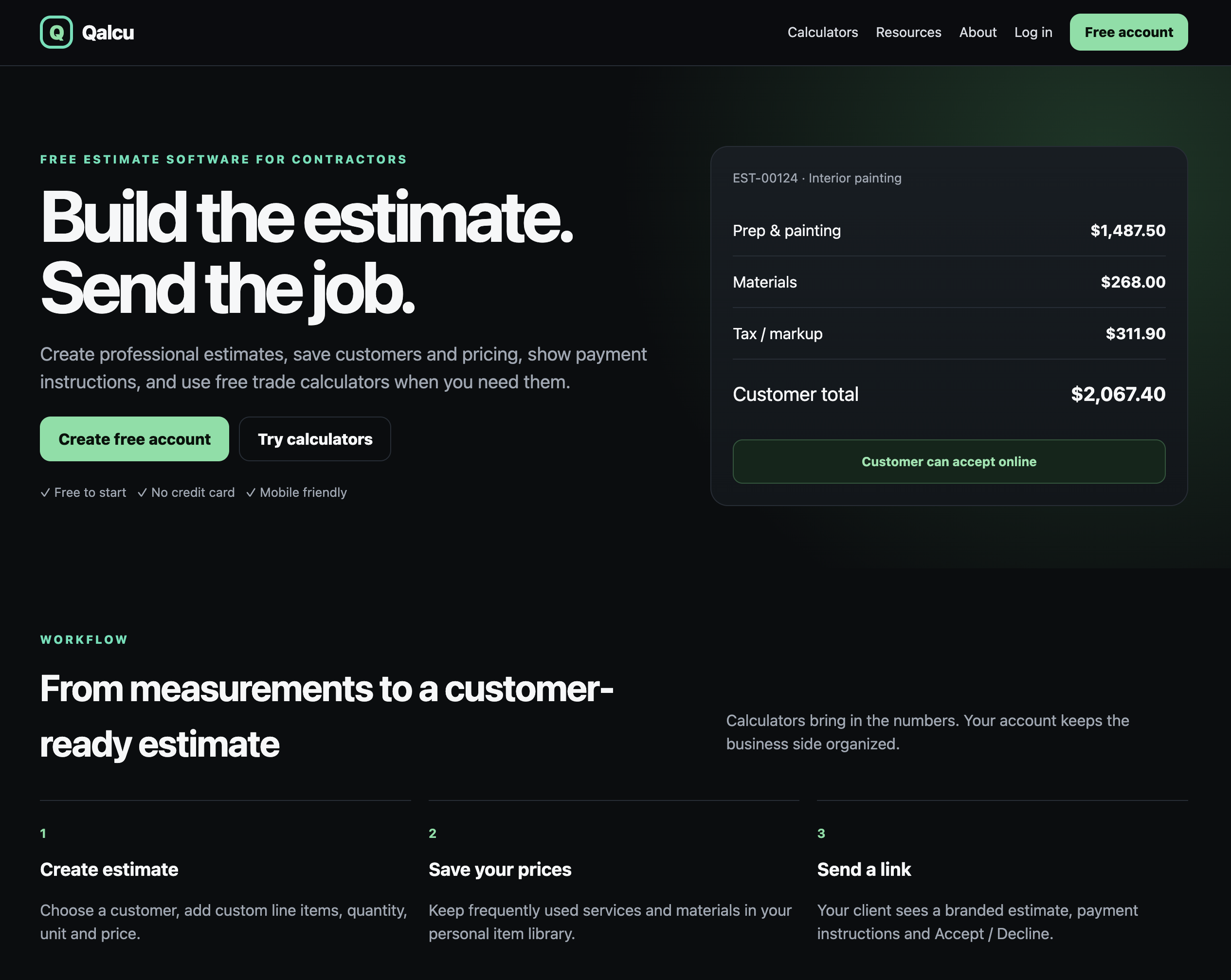
Contractors can create estimates with labor and material line items, organize customer information, reuse saved pricing, include payment instructions and generate a professional PDF estimate.
A customer-facing estimate can also provide a clear Accept or Decline decision, connecting the calculation to an actual business workflow.
Explore the complete product on the M&N Soft Qalcu page.
15 / WHEN A CALCULATOR IS NOT ENOUGH
Growing businesses eventually need repeatable processes, not only correct arithmetic.
As the number of customers and jobs increases, estimating becomes connected to customer management, approvals, documents, scheduling, invoicing and reporting. At that point, the challenge is no longer simply calculating a percentage.
The long-term goal of good business software is to reduce duplicate work and make information move through a consistent process.
16 / COMMON ESTIMATING MISTAKES
Most estimating problems are ordinary — and that is exactly why they are dangerous.
Common mistakes include forgetting small materials, ignoring waste, underestimating labor time, leaving direct expenses out of the job cost, confusing markup with margin and reducing a price without recalculating the resulting profit.
A repeatable estimating process cannot eliminate uncertainty, but it can make the assumptions visible before the work begins.
17 / FAQ
Contractor estimating questions.
What should a contractor estimate include?
The exact structure depends on the trade and project, but contractors commonly need to consider labor, materials, subcontractors, direct job expenses and the pricing decision that produces the final amount.
Is markup the same as profit margin?
No. Markup compares profit to cost, while margin compares profit to the selling price. A 20% markup therefore does not produce a 20% profit margin.
Can I make contractor estimates for free?
Yes. Qalcu provides free contractor estimating tools and a web-based workflow for creating estimates.
Do I need estimating software for every job?
Not necessarily. The important requirement is a reliable process. Software becomes increasingly useful when estimates, customers, pricing and documents need to be organized and reused.
18 / M&N SOFT + QALCU
Useful business software does not have to begin with a subscription.
Qalcu is an M&N Soft project created to give contractors and small businesses practical estimating tools in a straightforward web experience.
Learn more about Qalcu, open the free Qalcu application or explore more M&N Soft Engineering.